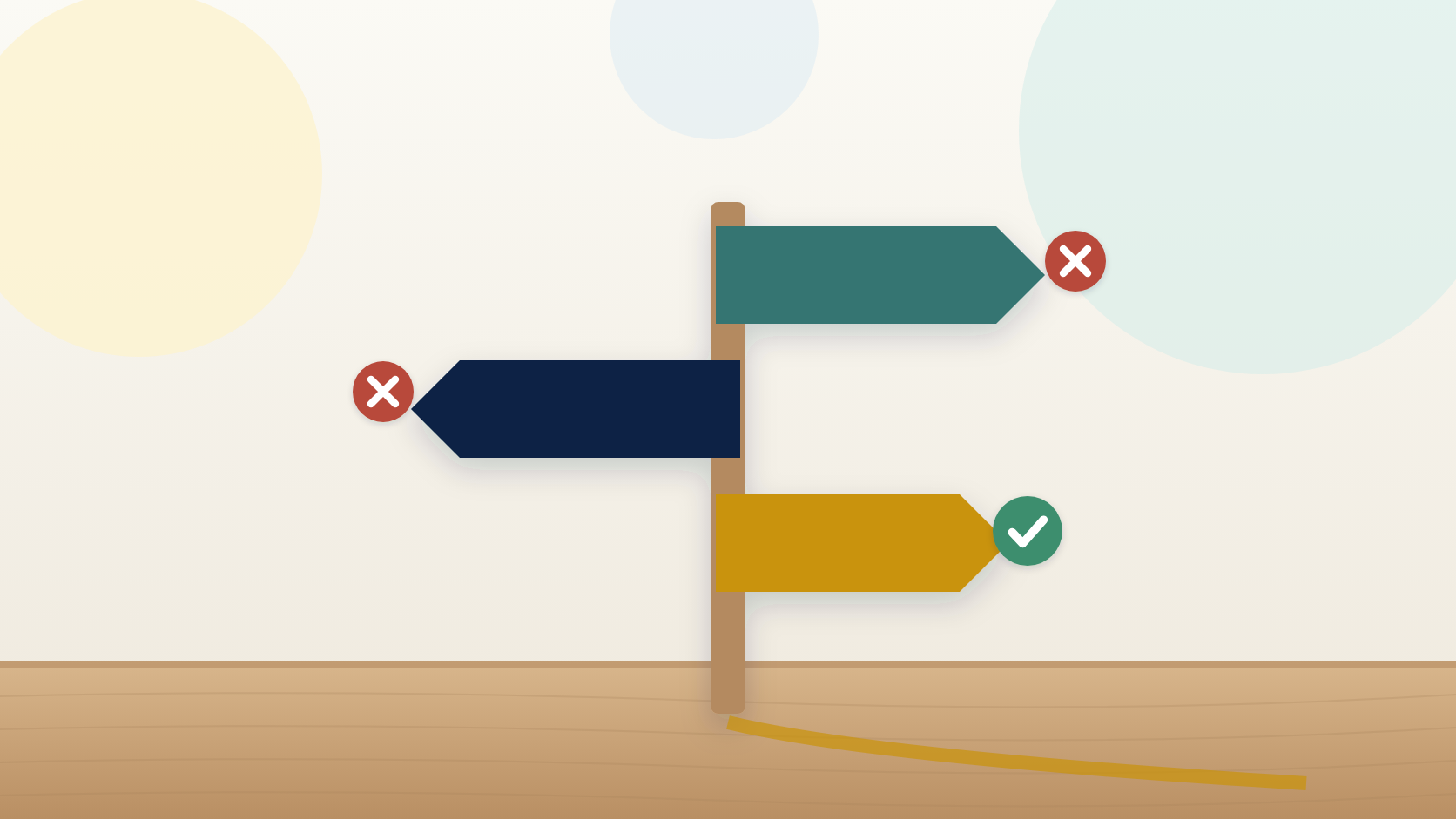
Strategy Is Mostly Deciding What NOT to Do
A real business strategy isn't a list of what you'll do — it's what you deliberately choose not to do. Here's why that decides who wins.
Ask most owners for their strategy and you'll get a list. Grow revenue. Improve quality. Reach more customers. Be the best. Every item is good. Not one of them is a strategy.
Here's the tell: if every competitor in your market would happily sign their name under your "strategy," it isn't one. "Be excellent and grow" is a wish everyone shares. A real strategy says something your competitor wouldn't agree to — because a real strategy is defined by what you're choosing not to do.
A wish list is not a strategy
A strategy is a roadmap for how you'll win — how you'll compete, keep customers, and make money over the long haul. The part people skip is that winning requires choosing, and choosing means giving something up. Every "yes" you commit to is a "no" to something else. If your strategy has no trade-offs in it, you haven't made any choices yet. You've made a wish list.
This is the hardest thing to accept about strategy, so let me put it bluntly: the "no" is the strategy. Deciding not to serve a certain customer, not to compete on price, not to add a product line everyone's asking for — those refusals are what give a business a shape sharp enough to win. A company trying to be everything to everyone has no edge, because an edge is, by definition, pointed in one direction.
Two ways to win, and you have to pick
In most markets there are broadly two ways to compete, and they pull in opposite directions.
You can win on price — be the cheapest and most efficient, and make your money on volume. Call it a commodity strategy. It's a real, respectable way to win, and the businesses that pull it off are ruthless about cost.
Or you can win on being different — better quality, a unique experience, something people will pay more for. Call it a differentiated strategy. Here you make your money on the premium, not the volume.
The trap is trying to do both. The cheapest option and the premium option at the same time is a contradiction, and customers feel it instantly. Picking a lane isn't a limitation. It's the entire point. The choice tells you what to invest in, what to charge, who to serve — and, crucially, what to walk away from.
One more useful way to see the lanes: most businesses that win are clearly best at one of three things. Some win on operational excellence — cheapest and most reliable, like a warehouse club. Some win on product leadership — the best, newest thing, like a top phone maker. And some win on customer intimacy — tailored, personal service that fits you exactly, like a good local firm that knows your name and your history. You can be decent at two. You can only be the best at one, and that one is your strategy. Trying to lead in all three is the surest way to lead in none.
What it looks like: the café that refused to fight on price
Let me make this real. Maya runs a small coffee roaster and café. A national chain opens down the street — deeper pockets, lower prices, faster line. On paper, she should be terrified.
She isn't, because she's made a choice. She is not going to fight the chain on price, and she's not going to try to be faster or cheaper. She knows she'll lose that fight every time. Instead she leans into the exact things the chain can't copy: beans roasted this week instead of shipped from a warehouse, a barista who knows the regulars by name, and a room by the river that people actually want to sit in.
Notice what her strategy rules out. No discounting to match the chain. No cutting quality to lower costs. No chasing the grab-and-go customer who only cares about speed and price — she cheerfully lets the chain have them. Those refusals aren't gaps in her plan. They are her plan. By deciding what she won't do, she's made everything else — what beans to buy, what to charge, how to train her staff — obvious.
A strategy that tried to win the price-conscious customer and the quality-conscious customer would have left Maya stuck in the middle: too expensive for one, not special enough for the other. The "no" is what keeps her sharp.
The honest caveat: saying no is uncomfortable, and that's the job
Here's why most businesses don't do this, even when they know they should. Saying no means turning away revenue that's sitting right in front of you. A customer wants something off-strategy and waves money at you. A competitor adds a feature and everyone asks why you don't have it. Every instinct says yes. Strategy is the discipline to say no anyway, because you know that chasing everything is how you end up sharp at nothing.
And to be fair, the caveat runs both ways: a strategy isn't a straitjacket. Markets shift, and sometimes the right move is to change the strategy on purpose — one company famously watched DVD rentals fade, saw streaming coming, and rebuilt around it. That's not abandoning strategy; that's making a new deliberate choice. The failure mode isn't changing your mind. It's never having made a choice in the first place.
This is also where I'd point you to what AI can and can't do. A tool can lay out your options, map your competitors, run the trade-offs, and pressure-test your thinking — fast. What it will never do is decide what you're willing to give up. That decision comes from knowing your business and your customers in a way no model has access to. The tool sharpens the choice. You make it. AI amplifies your judgment; it doesn't hand you a strategy.
So when you sit down to write yours, don't start with the list of everything you'll do. Start with the harder, more honest question: what are we choosing not to do? Answer that, and the rest of the strategy tends to fall into place.
Key takeaways
- If every competitor would happily sign under your "strategy," it's a wish list, not a strategy.
- A real strategy is defined by its trade-offs — the things you deliberately choose not to do.
- Most markets offer two lanes: compete on price (commodity) or on being different (differentiated). Pick one.
- Trying to be cheapest and premium at once leaves you stuck in the middle, sharp at nothing.
- AI can map options and run trade-offs, but deciding what to give up is a human judgment.
Frequently asked questions
What is a business strategy?
A business strategy is a roadmap for how a company will reach its long-term goals — how it will compete, attract and keep customers, and make money. The key part people miss is that a real strategy requires trade-offs: choosing what to do also means choosing what not to do. A plan with no trade-offs is a wish list, not a strategy.
What's the difference between a commodity and a differentiated strategy?
A commodity strategy competes on price and efficiency — being the cheapest and making money on volume. A differentiated strategy competes on being unique — better quality or experience that customers will pay more for, making money on the premium. Both can win, but trying to do both at once usually fails, because customers can tell you haven't chosen a lane.
How can a small business compete with a bigger, cheaper competitor?
Don't fight on their strengths. If a larger competitor wins on price and speed, competing there is a losing battle. Instead, lean into what they can't easily copy — personal service, local knowledge, quality, or a better experience — and deliberately let go of the price-focused customers. Choosing not to compete on price is a legitimate, often winning, strategy.
Why is saying no important in strategy?
Because focus creates an edge. A business trying to serve every customer and offer every product has no clear advantage — it's stretched thin and easy to beat. Deliberately declining off-strategy customers, products, or price wars keeps a business sharp and makes every other decision (what to charge, who to serve, what to invest in) clearer.
Build the strategy, not the wish list
Trade-offs are one idea from the strategy module of Business Essentials, where you run a gap analysis, build a SWOT, and write one focused goal — with AI as a sounding board that challenges your thinking.
See the course