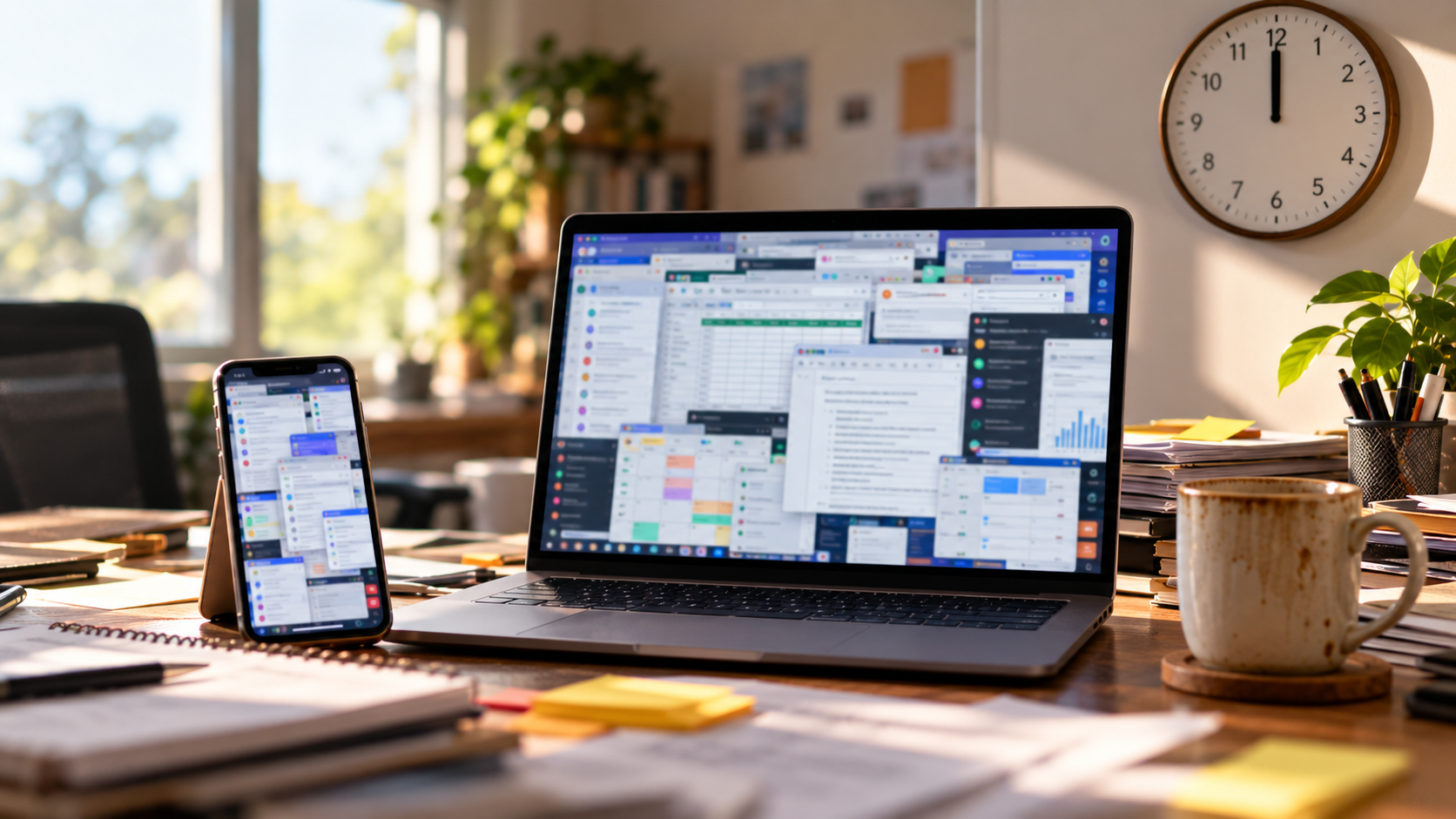
The Hidden Cost of Every App You Open
Twenty different apps I opened before lunch to get my work done. And that was just in the morning.
The Hidden Cost of Every App You Open
By Chris Daily
I counted them yesterday.
Twenty.
Twenty different apps I opened before lunch to get my work done. And that was just in the morning.
Email. Synthesia. PowerPoint. Word. Excel. Monday.com. Heygen. Outlook. Canva. Google Drive. Gmail. Menti.com. Medium. YouTube. LinkedIn. Grammarly. Dropbox. Gamma.app. My password manager.
Each one necessary. Each one specialized. Each one designed to do one thing really, really well.
And each one quietly draining my focus every single time I switched between them.
That's when I realized: my productivity stack wasn't helping me work faster. It was making me slower.
The Tax Nobody Talks About
We obsess over finding the "perfect" tools.
The best email client. The most elegant project management system. The note-taking app that finally organizes our thoughts. The communication platform that keeps everyone aligned.
We build these beautiful productivity stacks — carefully chosen apps that integrate (sort of) and promise to make us more efficient.
But here's what we don't talk about: Every time you switch between apps, you pay a tax.
Not in money. In mental energy.
Your brain has to remember where you were, reload the context, adapt to a different interface, recall different shortcuts and commands, and shift to a different mental model.
And it has to do this dozens of times a day.
Sound familiar? We all know that multi-tasking is bad, yet…
You don't feel it happening. But it's costing you more than you think.
The Switching Trap
Last week, I watched myself waste thirty minutes on a simple task.
I needed to pull data from a spreadsheet, summarize the key points, draft an email to my VA, schedule a meeting to discuss it, and create a task in our project tracker.
Five steps. Straightforward.
But here's what actually happened:
I opened Excel. Found the data. Copied it. Switched to Word. Pasted it. Started summarizing. Realized I needed more context. Switched back to Excel. Found the additional info. Switched back to Word. Kept writing. Got interrupted by a Google Chat notification. Checked it. Lost my train of thought. Returned to Word. Reread what I'd written. Finished the summary. Opened Outlook. Started the email. Realized I needed to check who was available. Opened Calendar. Found a time. Went back to Word. Forgot what I was writing. Checked Word again. Copied the summary. Pasted it into email. Sent it. Opened Monday.com. Created the task. Tried to remember all the details I'd just been working with. Gave up. Went back to the email to copy information into the task.
Fifteen application switches. For five simple steps. And it took me an hour.
And by the end? I was exhausted.
Not because the work was hard. But because my brain had spent more energy managing the tools than actually doing the thinking.
The Interface Illusion
Here's the lie we've been sold: specialization equals efficiency.
Use the best tool for each job. Email for communication. Docs for writing. Sheets for data. Chat for collaboration. Project management for tasks.
And in isolation? Each tool is efficient.
But we don't work in isolation.
We work across contexts. Across formats. Across mental models.
And every time we jump from one specialized tool to another, we're asking our brain to do something it's terrible at: rapid context switching.
Studies show it takes an average of 23 minutes to fully regain focus after an interruption.
But we're not just getting interrupted by notifications. We're interrupting ourselves every time we open a new app.
Because each app is its own world. Its own logic. Its own language.
And our brains have to translate between them constantly.
The Single Interface Revolution
I started using AI differently three months ago.
Instead of treating it as another specialized tool in my stack, I started treating it as the interface layer between me and everything else.
Need to pull insights from data? I ask AI. It doesn't replace my spreadsheet, but I don't have to leave the conversation to interact with it.
Need to draft an email? I ask AI. It doesn't replace Gmail, but I can think through the message without switching mental models.
Need to summarize a document, brainstorm ideas, check for errors, translate something, or reformat text? Same interface. Same conversation. No switching.
And something remarkable happened.
I got faster. Not because AI did the work for me. But because I stopped spending cognitive energy managing my tools.
The Consistency Advantage
Think about what you do when you learn a new app.
You learn its interface. Its shortcuts. Its quirks. Where things are hidden. How to make it do what you want.
You invest mental energy into building a map of that tool in your brain.
And then you do it again for the next tool. And the next. And the next.
You're learning seventeen different languages to do work that should speak one.
AI flips this.
Instead of adapting to the tool, the tool adapts to you.
You communicate the same way every time: in plain language, in a conversation.
You don't memorize commands. You don't hunt through menus. You don't rebuild your mental map seventeen times a day.
You just say what you need. And it handles the translation to whatever specialized function is required.
One interface. Infinite functions.
What I Got Back
I'm not saying AI replaced all my tools. It didn't.
I still use email. I still use spreadsheets. I still use project management software.
But now? I use them less often. And when I do use them, I use them with intention — not as pit stops in a workflow that requires constant jumping.
Because AI handles the in-between work. The translation. The formatting. The reorganizing. The summarizing. The connecting.
And what I got back wasn't just time. It was focus.
The kind of focus that comes from staying in one place long enough to actually think.
The kind that disappears the moment you open your eighteenth app of the day.
The best productivity tool isn't the one that does the most.
It's the one that lets you stop switching.
AI gave me that.
And it turns out, the cost I'd been paying all along wasn't in the tools I was using.
It was in the space between them.
Stop paying the switching tax
Automate with AI is built around exactly this problem — using AI as your single interface instead of adding one more app to the stack.