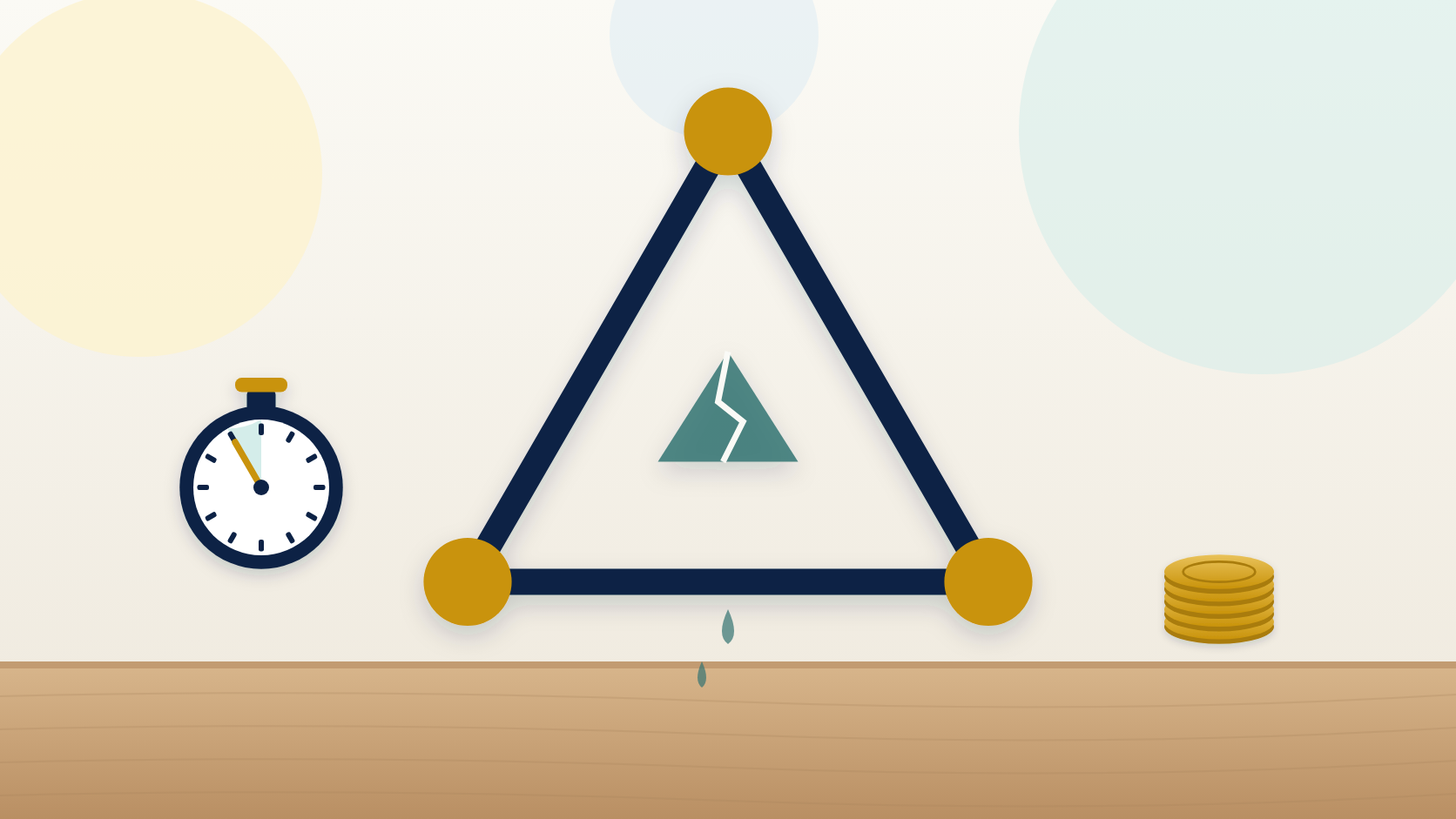
The Iron Triangle Always Pays Out of Quality
The iron triangle fixes scope, time, and cost — so quality silently absorbs every change. Here is what fixing time and cost instead actually buys a team.
A kitchen renovation, six weeks, eighteen thousand dollars, because family arrives at the end of week six and the flights are booked. The list is cabinets, counters, floor, sink, lighting, paint.
Two weeks in, the contractor opens a wall and finds old plumbing that has to be replaced. That is new scope. The date cannot move. The money is what it is. So the floor gets a cheaper underlayment, the second coat of paint is skipped, and the lighting goes in without the dimmers.
Nobody held a meeting to decide that quality would take the hit. It simply did, because it was the only side of the shape that could bend without anyone having to announce it.
That is the iron triangle, and it works exactly the same way at your job. Scope, time, and cost form the three sides. Quality sits in the middle — surrounded, unowned, and unscheduled. It is not a fourth thing you plan. It is the space left over after the other three have taken what they want.
I have run technology organizations for thirty years, and I have never once seen a leadership team gather to formally approve a quality reduction. I have seen the reduction happen hundreds of times.
Nobody chooses. That is the whole problem.
The comfortable version of this idea is "pick two: fast, cheap, or good." It implies somebody is choosing, deliberately, with the trade-off on the table.
On real projects nobody chooses. The scope is set by one group, the date is set by another, the headcount is set by a third, and none of them are in the room when the fourth thing quietly pays the bill. The stated goal of traditional project management is to keep all four elements in check. The predictable result has a name — out of balance — and it describes a specific mechanic: scope or cost increases on the same timetable, so quality suffers.
Read that again. Not might suffer. When three sides are held rigid and demand grows, there is exactly one place for the pressure to go.
The same squeeze looks different in every kind of team, and it is invisible in all of them on the day it happens:
- Software: legal adds a consent flow mid-quarter. Test coverage thins and the accessibility review moves to "phase two," a phrase that means never.
- Marketing: two more regional versions are added to a fixed launch date. Lighter copy edit, reused images, analytics tagging done in a hurry.
- HR: one more interview loop inside the same hiring window. Scorecards get written from memory two days later instead of right after the interview.
- Customer service: a new product line joins the same queue. Agents stop reading the full ticket history before replying.
- Finance: a new entity is added to the same monthly close. One reconciliation gets rolled forward instead of done.
That last one deserves a sentence of its own, because it is the pattern in its purest form. A team can hit its close date every single month for years and be praised for the streak, while one account that takes four hours nobody has is rolled forward each cycle. The dates are never missed. The quality has been paying for them the whole time, and the bill arrives in one lump when an auditor pulls the account.
Scrum fixes time and cost, and lets scope flex openly
Here is the move that makes Scrum work. It takes about ten seconds to describe and about six months to believe: turn the triangle over.
The mechanism is a two-part pattern. First comes the Request, which sounds like "we want to do this." Somebody names what they want, and there is nothing unusual about that.
Then comes the Response, and this is where everything changes: "During the next Sprint, with the following team, we can deliver this, and then this, and then this."
Read it slowly, because it does three things at once. It fixes time by naming a Sprint of a known length. It fixes cost by naming a specific team. And having locked those two, it treats scope as a sequence rather than a promise. Not "all of it by the end," but "this first, then this, then this."
Nothing was refused. Everything was ordered.
A customer service team asked to improve response time, deflect tickets with self-service articles, add a Spanish-language queue, and build a new escalation policy does not answer "yes, all four, by the end of the quarter." It answers: "In the next two weeks, with these five people, we can ship the escalation policy and the first eight articles. Then the Spanish queue. Then the rest of the articles."
That is not a refusal and it is not a negotiation about the date. It is a re-shaping of the ask into an order.
Flexible scope does not mean doing less
This is the sentence that loses the argument in most organizations, so get it right the first time. People hear "scope is flexible" and translate it as "the team has decided to under-deliver." If you let that reading stand you will never win a conversation with a manager again.
Flexible scope means the total is not promised in advance, so the order can respond to what is actually learned. The team is not doing less. It is doing the most valuable things first and letting the least valuable things be the ones that fall off the end, if anything falls off at all.
That matters because value is not spread evenly across a list of work. A handful of items carry most of the benefit and a long tail carries very little. When you fix scope, you commit to delivering the whole list, and you have to protect the worthless items as fiercely as the valuable ones, because they were all in the promise. When you flex scope, that low-value tail becomes the natural place for pressure to land — instead of quality.
So whenever you say scope is flexible, say the second half in the same breath: which means we deliver the most valuable work first and never hide a quality cut. The second half is the half that is actually true.
There is a rule that keeps this from turning into drift, and it is the part people miss. Across the product, scope flexes. Inside a single Sprint, scope is fixed. Zoom out and the list of what will eventually be delivered is open and reordered constantly. Zoom in on the two weeks you are living in and the work is settled: this is the goal, these are the items, this is the team, this is the end date, and none of it moves.
Flexibility lives at the boundaries. Stability lives inside them. The reason is not comfort — it is measurement. If the contents of an iteration change every day, you never learn what your team can actually finish, because you never ran a clean experiment. Teams that allow constant mid-Sprint changes are not just stressed. They are permanently uninformed about themselves, which is why their forecasts never improve no matter how many years go by.
When something genuinely urgent arrives mid-Sprint, the rule is not "refuse it." The rule is one in, one out, decided by the Product Owner, and announced to whoever asked. Same bag, same size. That last step — telling the requester what came out — is the single most effective way to reduce interruptions, because it makes the cost visible to the person creating it.
The honest caveat: your contract may already be signed
If your organization sells fixed-scope, fixed-date contracts, none of this arrives for free. You cannot flex scope that a signature has locked, and pretending otherwise is how teams get into trouble they did not need.
What you can do is narrow where the lock applies. Fixed-price work can still be delivered in ordered slices with a review at every boundary, so the customer sees real output early and can trade one item for another of equal size before the end. The commercial structure changes slowly. The delivery structure can change next month.
And there is a squeeze this framing will not remove. If two of your five people are pulled onto another project in week two, your cost side moved and you should expect to finish roughly sixty percent of what you planned. Most disappointing Sprints are not capacity failures. They are unnoticed cost-side changes that nobody wrote down.
Whatever else you take from this: go find the last time your team was squeezed, and write down not what got dropped from the list, but what got done worse. Things dropped from a list are visible. That other sentence is your organization's real quality trade, and naming it out loud is worth more than any diagram.
Key takeaways
- In the traditional triangle, scope, time, and cost are held rigid — so quality is the only side left that can absorb a change, and it does so silently.
- Nobody approves the quality reduction. Scope, date, and headcount are usually set by three different groups who are never in the room together.
- Scrum fixes time and cost and lets scope flex openly, which turns a promise about totals into a statement about order.
- Flexible scope means the most valuable work first, not less work. Always say the second half of that sentence.
- Across the product, scope flexes. Inside a Sprint it is fixed — otherwise you never run a clean enough experiment to learn what your team can finish.
Frequently asked questions
What is the iron triangle in project management?
The iron triangle, or traditional project triangle, holds scope, time, and cost as its three sides with quality in the middle. The stated intent is to keep all four in check. In practice, when scope or cost grows on an unchanged timetable, the three sides are held rigid and quality absorbs the difference — usually without anyone deciding that it should.
Why does quality always suffer in a fixed-scope project?
Because quality is the only element with no owner and no number attached. Scope is a list someone signed, the date was announced, and headcount is set by a budget. When new work arrives, those three are defended by named people, so the pressure lands on how well the work is done: thinner testing, lighter review, deferred documentation. None of it requires an announcement, which is why nobody notices until later.
What does it mean that Scrum fixes time and cost?
It means the Sprint length and the team are the promise, instead of the feature list. A Scrum team answers a request with a response: during the next Sprint, with this team, we can deliver this, then this, then this. Time and cost are locked, and scope becomes an order of delivery rather than a guaranteed total.
Does flexible scope mean the team delivers less?
No. It means the total delivered is not promised in advance, so the order of delivery can respond to what is actually learned. Value is never spread evenly across a list of work, so the least valuable items become the natural place for pressure to land instead of quality. The team does the same amount of work — it just does the most valuable parts first.
What should a team do when urgent work arrives mid-Sprint?
Apply an exchange rule agreed in advance: one in, one out, decided by the Product Owner, and announced to whoever made the request. The Sprint stays the same size. Telling the requester exactly what was dropped to make room is what makes the cost visible, and visible cost is the most reliable way to reduce future interruptions.
Where this goes next
Flipping the triangle is Module 4 of Scrum Essentials, beLithe's eight-module self-study class — alongside the Request-and-Response pattern, the exchange rule, and a straight answer to each of the eight myths people repeat about Scrum.
See Scrum Essentials