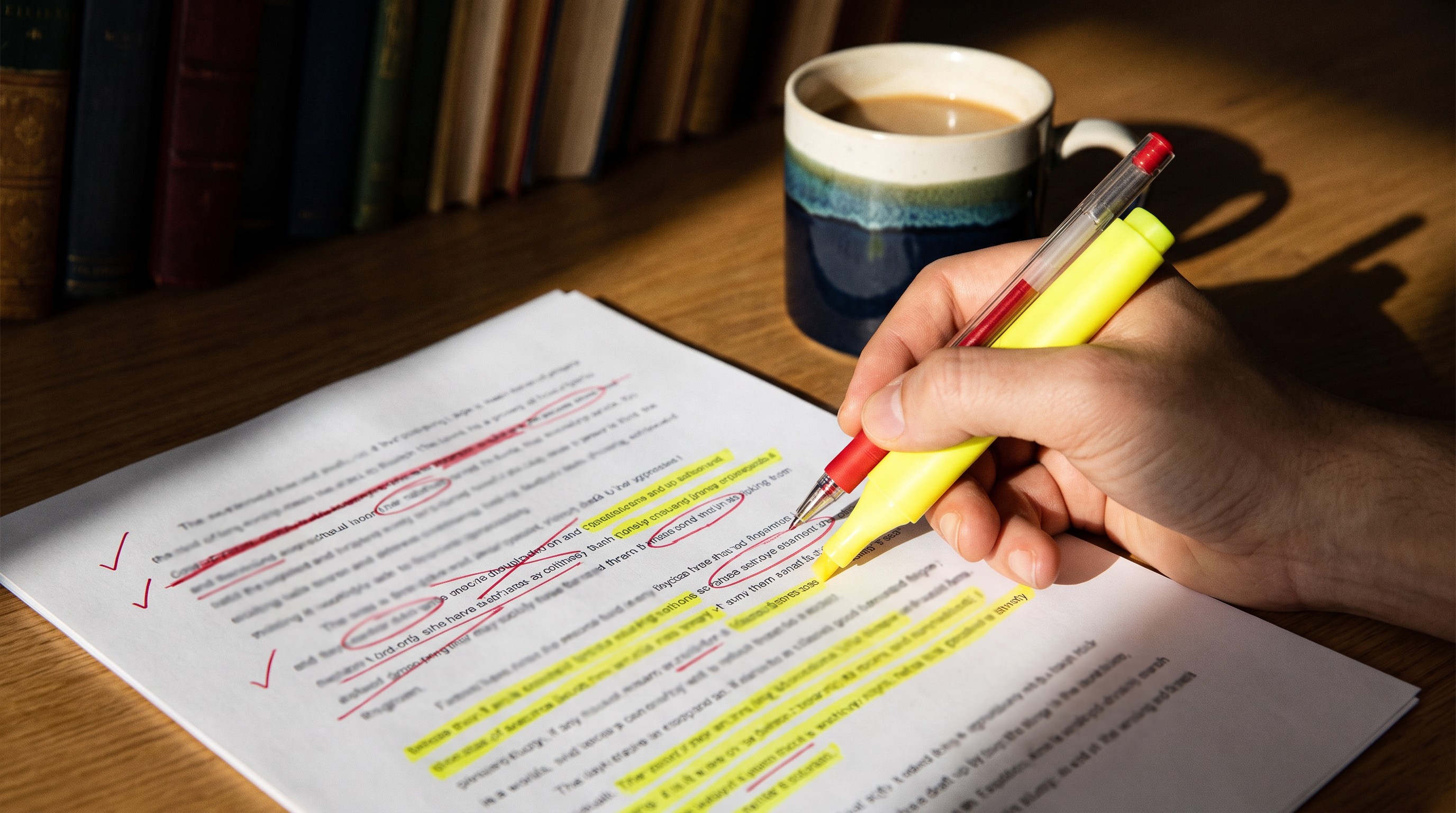
How to Edit AI Writing: The Four-Part Human Pass
AI drafts rarely fail on grammar. They fail on drifted facts, risky advice, and padding. Here's the four-part human pass I use before anything ships.
Here's an uncomfortable truth about AI writing. If you publish an AI draft without a real edit, you aren't using AI to create content. You're letting AI create content under your name.
Those are very different things. In the first, the tool amplifies you. In the second, it replaces you, and it does a worse job of being you than you would.
Most people know they should "edit" an AI draft. What they actually do is proofread it. They fix a typo, swap a word, maybe trim the intro, and ship it. Proofreading asks "is this written correctly?" That's the wrong question for an AI draft, because AI drafts are almost always written correctly. Grammar isn't where they fail.
If you want to know how to edit AI writing so it's true, safe, and yours, you need a different pass with different questions. I call it the human pass. Four parts, in order: fact re-check, judgment, cut, add. The questions are: Is this true? Is this right? Is this necessary? Is this mine?
AI drafts don't fail on grammar. They fail on drift.
Start with facts, because a wrong fact is the one mistake that can cost you trust in a single post. A clunky sentence costs you a little attention. A wrong number can cost you a client.
You'd think the risk is wild invention. When you've given the AI real facts to work with, that's actually not the usual problem. The usual problem is drift. The AI takes your verified fact and makes it a little bigger.
Here's a worked example from the course. A landscaper's verified fact was: mowing hours on the converted area dropped by more than half by year three, on three of his client jobs. The AI draft said: native plantings cut maintenance costs in half.
That sounds like the same fact. It isn't. Hours aren't costs. Three jobs aren't a general rule. "By year three" isn't "always." Each small drift makes the claim bigger than the evidence.
Drift is worse than invention, because an invented number looks unfamiliar and drift looks like your own fact. Your credibility lives in the small words: "more than half" versus "half," "my clients" versus "businesses," "after year three" versus "over time."
The human pass: four parts, in this order
1. Fact re-check. Mark every factual claim in the draft: every number, date, name, "research shows," and statement about how something works. For each one, find it in your notes. If the draft matches, it's fine. If it drifted, fix it back to what you actually verified. If it isn't in your notes at all, the AI added it. Verify it now, cut it, or rewrite it as clearly labeled opinion. Phrases like "studies show" and "many businesses find" are fact-check items, not style items. They're where AI writing slides from sounding generic to being wrong.
2. Judgment. The facts can all be correct and the piece can still be wrong. Read every recommendation and ask: Would I say this to a client's face? Is anything here risky for my reader? Does it overpromise? Is it fair to people who disagree? This is the part AI can't do for you. It knows what's commonly written. It doesn't know your clients, your market, or the advice you've watched go wrong.
3. Cut. AI drafts run long, and the extra length isn't where the value is. Cut in this order: the warm-up first paragraph, the summary ending, repeated points, the phrases that make readers think "a machine wrote this," and anything that doesn't serve your main point. A good target for a first pass is 15 to 25 percent shorter.
4. Add. Now add what only you have. A short real story. A specific detail from your own work. A plain opinion. This is what turns a decent draft into something people remember, and it's the one thing a competitor can't copy with the same prompt.
The order matters. You check facts first so you don't polish a sentence that's about to get cut for being wrong. You cut before you add so you can see how much room you have. You add last because your story often becomes the strongest part, and you want it landing in a clean draft.
What it looks like in practice
Another example from the course. Jordan runs a small physical therapy clinic. He drafted a one-page handout for new patients, "Your First Two Weeks: The Three Exercises That Matter Most." The AI draft came in at 640 words.
Fact re-check. He found nine factual claims. Six matched his notes. Two had drifted. His clinic records said about half of patients report skipping exercises by week two. The draft said most patients abandon their home program "within days." He fixed it back to his wording, labeled as the clinic's own experience. The ninth claim, that consistent home exercise "cuts recovery time in half," wasn't in his notes at all. He couldn't verify it. He cut it.
Judgment. The draft said, "If an exercise causes pain, push through gently; mild discomfort is part of healing." Grammatically fine. Plausible. And for a nervous patient reading alone at home, possibly dangerous. He rewrote it: some soreness is normal, sharp pain or pain that's worse the next morning is not, stop and call us. He also cut a line telling patients to add reps as they feel stronger, because progression is his therapists' call at each visit, not a handout's.
Cut. He deleted an opening paragraph about "the importance of active participation in your recovery" and started with the three exercises. He dropped a closing summary that repeated the list, plus an "it's not just about exercise, it's about building habits" line. 640 words became 470, which fit on one printed page. That was a real requirement for something handed across a front desk.
Add. Two lines only his clinic could write: put the sheet on the fridge or next to your toothbrush, and "We'll text you on day four. Reply with one word: easy, okay, or hard." The text check-in was a real change the clinic had made. Now the handout and the business match.
Look where the time went. The fact check and the cut were mechanical. The judgment step took longest and mattered most. Nothing in the pain advice was obviously invented. It was reasonable general advice that was wrong for this reader in this situation. Only someone who has treated real patients would catch it.
What the human pass costs, and what it doesn't fix
It takes time. For a 1,000-word article, expect your first few passes to take 20 to 40 minutes. That gets faster as your eye for drift and filler improves. For a short social post, five or ten minutes.
Some people hear that and say it defeats the purpose of AI. I see it the other way. The time you spend is on the parts that matter: deciding what's true, what's right, and what's yours. That's the amplifier. AI does the fast middle. You own the ends.
You can still use AI during the pass, but its job changes. It's your assistant now, not your writer. "List every number and factual claim in this draft so I can check them" is a good use. "Which two paragraphs say the same thing?" is a good use. "Fix this draft" hands your judgment back to the machine.
And one hard line. Never ask AI to "add a personal anecdote." It will. It'll sound plausible. And it'll be fiction presented as your life. Publishing it is the same as publishing a made-up statistic, except it's about you. Your stories come from your memory, your notes, your voice memos. AI can help you tighten a story you wrote. It should never write one for you.
When the stakes go up (health, money, legal, safety, employment), spend more of the pass on judgment. And when you're not sure, have a qualified colleague read it before it goes out.
Key takeaways
- Proofreading asks if a draft is written correctly; the human pass asks if it's true, right, necessary, and yours.
- Drift is worse than invention: AI quietly makes your real facts bigger than your evidence.
- Run the four parts in order: fact re-check, judgment, cut, add.
- Judgment is where the real risk lives, especially for health, money, legal, safety, or employment content.
- Never let AI invent a personal story. Your experience has to come from you.
Frequently asked questions
What is a human pass on AI-written content?
A human pass is a structured edit you do yourself after an AI tool drafts something. It has four parts done in order: re-check every fact against your verified sources, apply your judgment to every claim and recommendation, cut what doesn't serve the reader, and add what only you can add, such as a real story or a clear opinion. It goes well beyond proofreading.
What is fact drift in AI writing?
Fact drift is when an AI draft restates a real fact you gave it in a slightly bigger or broader form. For example, "maintenance hours dropped by more than half on three client jobs" becomes "cuts maintenance costs in half." Drift is hard to catch because it looks like your own fact. Compare quantities, scope, and conditions word by word against what you verified.
How long does it take to edit an AI draft properly?
For a 1,000-word article, a careful human pass usually takes 20 to 40 minutes the first few times, getting faster with practice. A short social post takes five to ten minutes. The time goes to checking facts, making judgment calls, cutting padding, and adding first-hand detail, which are the parts that decide whether the piece is credible.
Should I ask AI to add a personal story to my content?
No. If you ask an AI tool to add a personal anecdote, it will write a plausible story that never happened and present it as your experience. Publishing that is fabrication, just like publishing an invented statistic. Write your own stories from memory, notes, or voice memos, and use AI only to help tighten a story you wrote yourself.
How much should I cut from an AI-generated draft?
A reasonable target for a first human pass is to cut 15 to 25 percent of the draft. Start with the warm-up opening paragraph and any summary ending, then remove repeated points, filler phrases that signal machine writing, and anything that doesn't support your main point. Shorter drafts usually read as more confident and more human.
Where this goes next
The human pass is the last step of the Kickstart Sequence in Module 4 of my class How to Use AI for Smarter Research & Creative Ideas, where it becomes part of your Research-to-Content Playbook.
See the class