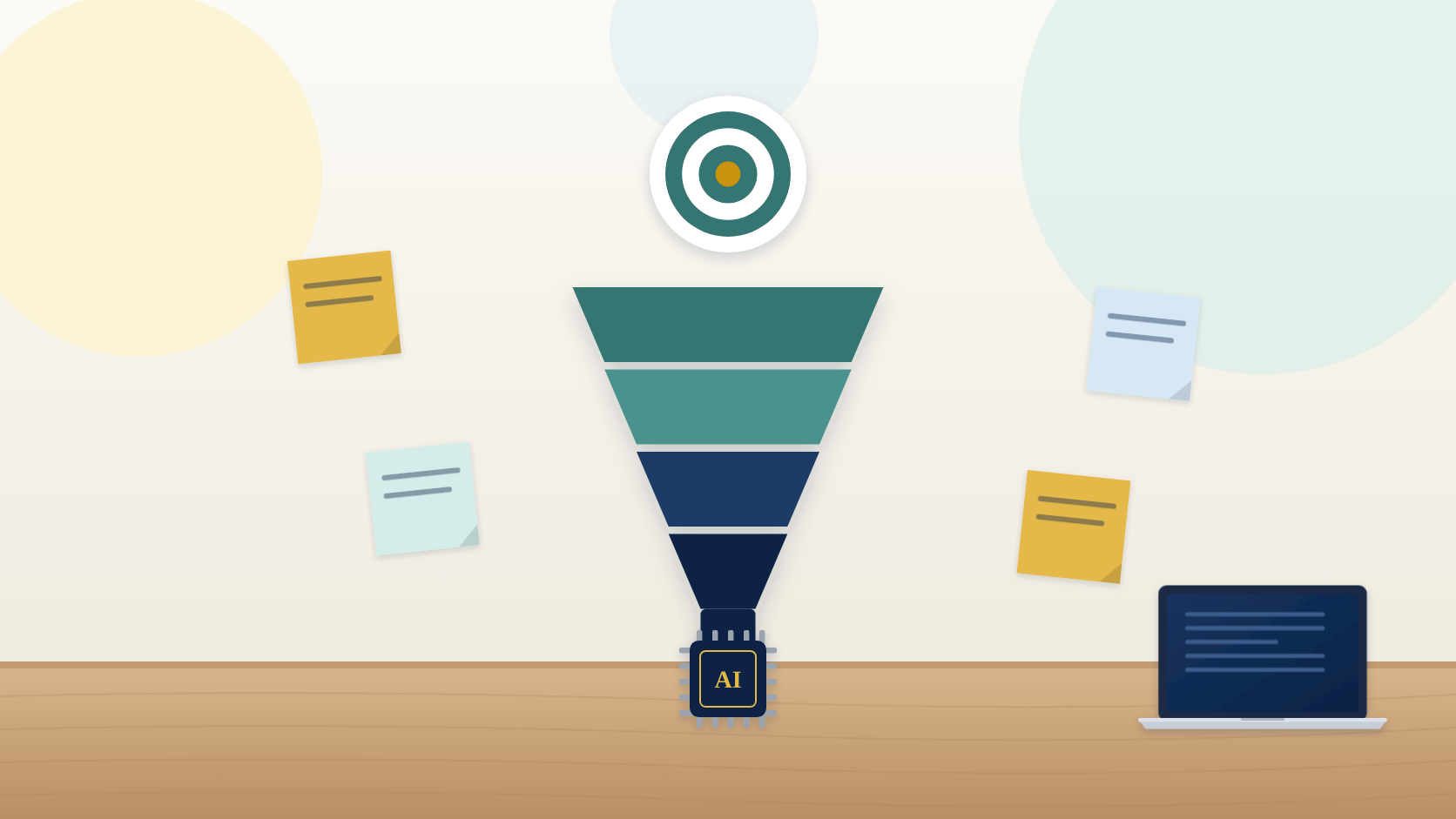
How to Choose AI Tools for Your Small Business: Goals First
Stop shopping for AI tools. Learn the Goals-First Funnel: pick one business objective, find the tasks, and only then choose the tool.
Here's a question I ask owners who tell me AI isn't working for them: what business number was that tool supposed to change?
Most of them can't answer. They can tell me the name of the tool. They can tell me where they saw the demo. They can't tell me the number.
That's not a character flaw. It's the order they thought in. They started with the tool and hoped a reason would show up later. It usually doesn't.
So if you're trying to figure out how to choose AI tools for your small business, here's my answer up front. Stop choosing tools. Choose a goal. The tool is the last decision you make, and it's the least important one.
You don't have a tool problem. You're in the Shiny Tool Trap.
Picture Maria. She runs a two-location bakery. Over one spring she signs up for an AI writing app, an AI image generator, a chatbot for her website, and a meeting note-taker. Each one looked great in a demo. Each one was the thing people in her online groups were talking about.
Six months later she's paying for all four and using one, a little, for Instagram captions. Her real problem never changed. She spends her Sunday nights doing staff schedules and wholesale orders by hand. Not one of those four tools touched it.
Maria didn't lack tools. She lacked a list.
I call this the Shiny Tool Trap: picking an AI tool because it's popular or new instead of because it moves a business goal. You see a demo, a friend raves, a vendor sends a slick email, and you sign up. The tool comes first. The reason comes later, if it comes at all.
Here's how to tell if you're in it:
- You pay for at least one AI tool you haven't opened in a month.
- You can name the tool you use but not the business number it was supposed to change.
- You signed up because of a demo, a post, or a conference talk, not a problem you had written down.
- You've tried three or more tools for the same kind of job and kept none of them.
- When someone asks "Is AI helping your business?" your honest answer is "I think so? Maybe?"
If two of those hit home, you're normal. Almost every owner I work with starts here.
The trap costs more than the subscriptions. Every tool takes hours to learn, and those hours come out of your week, not the vendor's. AI output has to be checked, and a tool that saves 30 minutes but takes 40 to check is a loss. Every new login pulls your attention away from customers and crew.
And then there's the worst cost. After two or three tools flop, owners decide "AI isn't for a business like mine." That closes the door on the tools that would have helped.
Picking the AI tool is the least important decision you'll make
Most owners believe the big risk is picking the wrong product. So they read comparison posts and watch reviews for hours.
That's backwards. Wrong product is a small risk. You can cancel a subscription in two minutes. The big risk is pointing a good tool at the wrong problem and concluding that AI doesn't work for you. The best tool in the world, aimed at a goal you don't have, is worth exactly nothing.
The other thing that pushes people tool-first is the fear of falling behind. You hear your competitors are all using AI, so you feel you need something, anything, right now. Slow down. Most of your competitors are in the trap too. The owner who wins isn't the one with the most tools. It's the one who quietly gets two hours a week back on the task that matters most and keeps doing it for a year. Speed of adoption isn't the score. Results are.
The fix is the Goals-First Funnel: objective, then tasks, then tools
The fix isn't to stop using AI. It's to change the order you think in. I call that order the Goals-First Funnel, and it runs one direction only:
Business Objective → Tasks → Tools.
Think about grocery shopping. Walk in hungry with no list and you leave with snacks, a fancy olive oil you'll never open, and nothing for dinner. Walk in with a list built from three meals you plan to cook, and you spend less, waste less, and actually eat. Same store. Same shelves. Different order.
The funnel works in four moves, done in order:
- Pick one Business Objective. A Business Objective is a result the business needs. Most fall into four buckets: more revenue, more capacity, fewer errors, or faster response. If you're turning work away, it's capacity. If customers say you're slow, it's response. If you keep fixing mistakes, it's errors. If the calendar is open and the bank account is thin, it's revenue. Pick one. Not five.
- List the tasks that touch it. Be concrete. "Marketing" isn't a task. "Writing the weekly email to past customers" is. Here's a good test: could you watch someone do it and time it with a stopwatch? Aim for five to fifteen tasks, including the ones that slow the objective down.
- Find the time sinks that don't need you. For each task, ask two things. How many hours a week does it take? Does it need my judgment, or does it follow a pattern? High hours plus low judgment is where AI earns its keep.
- Then, and only then, look at tools. Search for the task, not the brand. Search "draft a quote from job notes," not "best AI app."
Notice what's not a Business Objective. "Use AI more" isn't one. "Get on ChatGPT" isn't one. Those are activities. A Business Objective is something your bank account, your customers, or your calendar would notice.
What the Goals-First Funnel looks like on a real Tuesday
Picture Dana Reyes. She owns a six-person HVAC and plumbing company. Four techs in trucks, a part-time office helper, and her. Quotes pile up on her desk. Follow-up calls slip. She does another hour of paperwork after dinner.
At a trade show, a vendor demos an AI phone receptionist. It answers calls, books jobs, and chats in a friendly voice. The booth is packed. Dana almost signs up on the spot.
Then she asks herself one question: "Is the phone actually my problem?"
She thinks about the last month. Nobody said "I couldn't get through." Three people said some version of "I'm still waiting on that price." Two of them went with another company. One of her techs heard that a competitor emailed a quote from the driveway.
The phone wasn't the bottleneck. The gap between the site visit and the quote was.
So Dana ran the funnel. Her objective, written so she could measure it: "Cut quote turnaround from 3 days to same-day by June 30." Her first task list said "quotes." Too broad. Broken down, quotes became six tasks: reading the tech's notes, looking up parts prices, deciding the price, typing the quote, emailing it, and following up.
That changed everything. "Quotes" as one blob felt like work only Dana could do. Six steps showed her the truth. Typing and follow-up emails were pattern work. Deciding the price was judgment. Now her tool search was small and specific: something that turns tech notes into a draft quote she reviews.
Here's the same pattern in three other businesses:
| Owner | Shiny tool they wanted | What the goal actually needed |
|---|---|---|
| Jen, solo bookkeeper | A website chatbot for night questions | Automatic reminders for missing receipts and statements |
| Marcus, dog groomer | AI videos of the dogs for social | Confirmation texts to cut about six no-shows a week |
| Ava, candle shop | Magazine-style AI product photos | Drafted replies to her ten most common customer emails |
Look at that last column. Reminders. Confirmations. Drafted replies. Not glamorous. That's the point. The work that eats a small business owner's week is usually plain and repetitive, and that's exactly what AI handles well. The shiny tools chase the fun, visible stuff. The goal-first tools go after the grind. Guess which one gives you your evenings back.
Where goals-first won't save you
I'll be straight about the limits.
It's slower at the start. You spend an hour on a goal and a task list before you touch a tool. That feels like falling behind. It isn't, but it feels that way.
It forces you to say no. One objective means the other four wait until next quarter. That's uncomfortable, and it's also why it works.
Your first guesses at hours will be low. Most owners guess low on the small, repeated tasks. A rough guess is fine for a first pass, but you'll want real numbers before you spend real money.
And the funnel doesn't pick the brand for you. It shrinks hundreds of options down to a handful. You still have to compare that handful honestly and test the winner on real work.
What it does give you is a calm way to say no. Every new tool that crosses your feed gets one quick test: does it help with a task that drives my objective? If not, admire it and move on without guilt. You don't have to keep up with every launch. You only have to keep up with your own goal.
AI is not replacing you. It's amplifying you. But an amplifier makes your signal louder. It doesn't pick the song. You pick the song.
Key takeaways
- The Shiny Tool Trap is picking an AI tool because it's popular or new instead of because it moves a business goal.
- Picking the wrong product is a small risk; pointing a good tool at the wrong problem is the big one.
- The Goals-First Funnel runs one way: Business Objective, then Tasks, then Tools.
- Search for the task, not the brand: 'draft a quote from job notes,' not 'best AI app.'
- A clear objective gives you a guilt-free way to say no to every new launch.
Frequently asked questions
How should a small business choose an AI tool?
Start with one business objective, not a tool. Pick a result the business needs, such as more revenue, more capacity, fewer errors, or faster response. List the recurring tasks that drive that result, find the ones that take lots of hours but follow a pattern, and only then search for a tool that helps with one specific task. Searching for the task instead of the brand turns hundreds of options into a short list.
What is the Shiny Tool Trap?
The Shiny Tool Trap is picking an AI tool because it's popular or new instead of because it moves a business goal. It usually starts with a demo, a friend's recommendation, or a vendor email. Common signs include paying for tools you haven't opened in a month, trying several tools for the same job and keeping none, and not being able to name the business number a tool was supposed to change.
What is the Goals-First Funnel?
The Goals-First Funnel is a sequence for adopting AI tools: Business Objective, then Tasks, then Tools. You start with a result the business needs, identify the recurring work that drives or blocks that result, and look for a tool last. Because tools come last, the funnel filters the market down to a handful of options that serve a goal you actually chose.
Is picking the wrong AI tool a big risk for a small business?
Usually not. Most subscriptions can be cancelled in minutes, so the wrong product is a small, recoverable mistake. The bigger risk is aiming a good tool at a problem the business doesn't have, seeing no result, and deciding AI doesn't work for a business like yours. That false lesson can keep an owner away from tools that would have helped for years.
Do I need to keep up with every new AI tool release?
No. Once you have a clear business objective, every new tool gets one test: does it help with a task that drives that objective? If it doesn't, you can skip it without guilt. Small business owners who get results tend to adopt fewer tools and use them consistently on the work that matters most, rather than chasing every launch.
Where this goes next
Module 1 of my self-study course, AI Tools That Drive Growth, takes you from one Business Objective to a measurable Objective Statement and your Top 3 AI Opportunities, step by step.
See the course