The Flat Backlog Problem: Why Lists Hide Your Product
A flat backlog tells you what to build next, but sorting by priority destroys sequence — so the product disappears into the list. Here is what a story map adds.
You have almost certainly sat in this meeting. A backlog opens on a shared screen. It runs to four hundred rows. Every row is a well-formed user story with a role, an action, and a benefit, because your team is disciplined and someone ran a workshop about it two years ago. Then a stakeholder asks the most reasonable question in the world — "so what does the product actually do?" — and nobody can answer without scrolling.
The stories are all there. The product is not.
I have watched that moment play out in boardrooms and in sprint reviews for thirty years, and for most of those years I assumed it was a discipline problem. Better grooming. Tighter acceptance criteria. A cleaner tool. It is none of those. The gap is structural, and once you can name it, you stop trying to fix it with effort.
A flat backlog is a one-dimensional, priority-ordered list of work items. That single sentence contains the whole problem. One dimension. Your product has at least two.
A flat backlog answers one question well and everything else badly
Be fair to the artifact first. A flat backlog is excellent at answering "what do we pull next?" That is a real question, asked every day, and a ranked list answers it faster than anything else anyone has invented. Keep it.
Now watch it fail at the rest. What does the product do end to end? Who is it for? What would a customer experience if we shipped only the top twenty rows? What could we safely leave out? Every one of those requires you to reconstruct a whole from a sequence of unrelated sentences, holding each in working memory while you compare it to the others. Working memory holds roughly four to seven items. A four-hundred-row list exceeds that by two orders of magnitude, so you never hold the product in your head at all. You hold a small moving window and infer the rest, and so does everyone else in the room — each of them inferring something slightly different.
Sorting by priority destroys sequence
Here is the mechanism, and it is worth being precise about because the fix follows directly from it.
In a real product, a user searches before they select, selects before they pay, and pays before they get a confirmation. That order is not a preference. It is the shape of the thing. In a priority-sorted list, the payment story sits at row 3 and the search story at row 180, because payment felt urgent the week the backlog was groomed. The list is now correct by one measure and unusable by another. The narrative — the order in which a human being actually moves through your product — has been shredded, and no amount of re-reading puts it back.
There is a second failure that costs more money. A flat backlog cannot show you what is missing, because absence has no row. If nobody wrote the story for "customer cancels an order," there is no empty slot where it should have been. There is simply nothing, and nothing looks exactly like a product where cancellation was deliberately excluded.
A team I know built a warehouse-picking app and worked a 300-item backlog for two sprints. Every story was clean and estimated. In the sprint 2 review, a warehouse supervisor watched the demo and asked what happens when a picker scans an item and the bin is empty. There was no story for it. There had never been a story for it. It had not been deprioritized — it had never been thought of, because nothing in a flat list ever asks "and then what?" Two sprints of work needed rework, because the exception path changed the data model.
A story map adds the second dimension
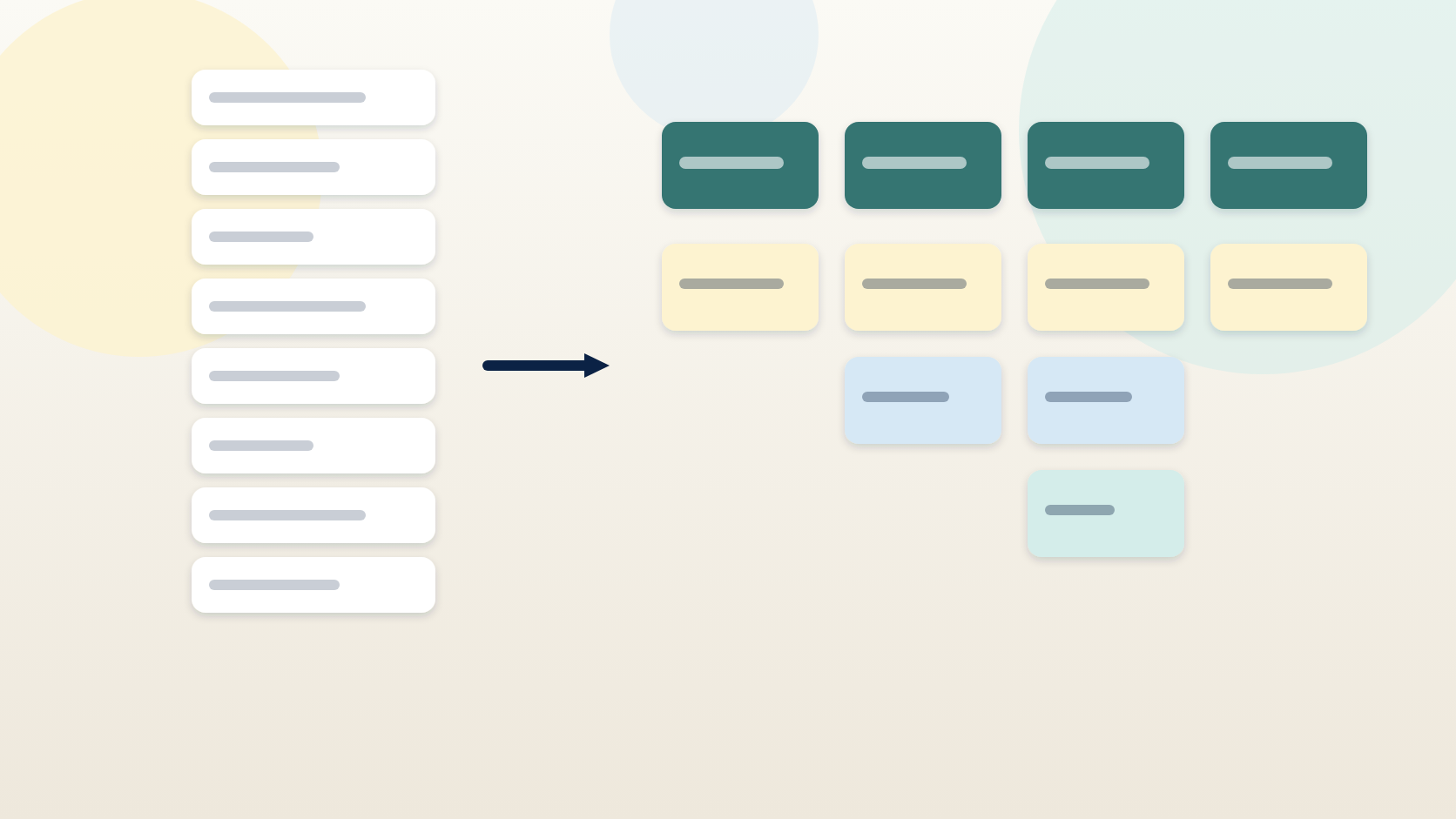
A story map is the same stories, arranged so that position carries meaning.
Left to right, the map holds sequence. Across the top runs the backbone: the major user tasks in the order a person performs them. Search for a book. View a book. Add to cart. Enter shipping. Pay. Receive confirmation. Track the shipment. Short verb phrases, not features. The backbone is the single most valuable row on the wall, because it is the row you read aloud when you want somebody to understand the product in ninety seconds.
Top to bottom, the map holds priority. Under each backbone task hangs a column of stories, most essential at the top, variations and refinements below. Under "Pay," the column might read: pay by credit card; pay by stored card; pay by gift balance; pay by cash at pickup; split across two methods. Ship only the first and the product works. Ship all five and the product works slightly better for a small number of people, at roughly five times the cost.
Above the backbone sit the user types — the personas whose journeys the map describes, including the ones that are not people. A nightly batch job, a partner API, a payment callback: each consumes and produces behavior, each has a journey with steps that can be missed. Teams that map only humans discover their integration work late.
And then the piece that makes the whole thing worth building: a release line drawn horizontally across the map. Everything above it is a commitment. Everything below it is a candidate. It is the only artifact in common agile practice where a scope decision is visible to everyone at once, in the context of the entire product.
What that looks like on a real product
A team mapping a small online bookstore ended with a ten-task backbone and thirty-eight stories. Their first release was eleven stories, and the interesting part is which eleven.
The top row spanned the entire backbone: search by title or author; cover, price and availability; add one item to a cart; continue as guest; one address at standard speed; pay by credit card; email receipt with an order number; a tracking link in that email. An entire backbone column — read reviews — shipped with nothing in it at all, and the product still worked, because a buyer who knows which book they want does not need reviews to buy it. Returns shipped as a manual process: a support person handling roughly forty cases a week by email, which was cheaper than building self-service returns before anybody knew the return rate.
Both of those are decisions, not gaps, and both are visible on the wall. That is the point. Six weeks later, when someone asks why self-service returns are not in the release, the answer is on the map with a reason attached instead of in somebody's memory.
Two tasks on that backbone were discovered only when the team walked the map out loud: choose a shipping speed, which changed the checkout math, and receive a delivery exception notice, which had no owner anywhere in the organization. Support had been handling forty cases a week of it by hand. Two people had built careers around a gap that was invisible on the backlog and obvious the moment the journey was drawn left to right.
Keep the backlog — the map does not replace it
This is where teams overcorrect, so let me be blunt. The map is not a prettier backlog, and you do not migrate one into the other. They answer different questions and you need both.
The backlog is where refined, ready work lives, and it is what your tracking tool wants. The map is what you build and maintain alongside it so the backlog stays honest. When a stakeholder asks what the product does, you point at the map. When a developer asks what to pull next, you point at the backlog. When the two disagree, fix the map first and then the backlog — the map is the picture of the product, the backlog is the queue of work, and fixing the queue without fixing the picture is exactly how drift starts.
One more rule, because breaking it is the fastest way to end up back where you began: the backbone is sequenced, not prioritized. Left to right means "happens before," never "matters more." The moment somebody slides the most important theme to the far left so the important stuff is first, the map stops telling the story of the product and becomes a ranked list rotated ninety degrees. Priority lives on the vertical axis. That is the only place it lives.
Key takeaways
- A flat backlog is one-dimensional; sorting by priority destroys the sequence a user actually moves through.
- A backlog cannot show what is missing, because absence has no row — gaps get found in demos instead of in planning.
- A story map holds sequence left to right and priority top to bottom, so the product becomes readable in ninety seconds.
- The release line is the only common agile artifact where a scope decision is visible to everyone at once.
- Keep both artifacts: the map answers questions about the product, the backlog answers questions about the work.
Frequently asked questions
What is a flat backlog?
A flat backlog is a one-dimensional, priority-ordered list of work items — the standard product backlog most teams keep in a tracking tool. It is very good at answering what to pull next, and poor at showing what the product does end to end, who it serves, or what is missing, because a list has only one axis and a product has at least two.
Why can't a product backlog show what the product does?
Because sorting by priority destroys sequence. A user searches before they pay, but in a priority-ordered list the payment story may sit at row 3 and the search story at row 180. The order in which a person actually moves through the product is lost in the ranking, so the narrative of the product cannot be read off the list at any length.
What is a story map?
A story map is an arrangement of user stories in two dimensions. User types run across the top, a backbone of major user tasks runs left to right in the order a person performs them, and stories hang beneath each task from most essential to least. A horizontal release line divides what ships first from what is deferred. The layout is the information.
Does a story map replace the product backlog?
No. They answer different questions and mature teams keep both. The map shows what the product is, who it serves, and what is missing; the backlog holds refined, ready work for the team to pull. A useful rule is that only stories above the release line become tickets — everything else stays on the map, visible and unrefined.
Should the backbone be ordered by priority?
No. The backbone is sequenced, not prioritized: left to right means "happens before," not "matters more." Reordering backbone columns by importance is the most common story-mapping mistake, and it turns the map back into a ranked list rotated ninety degrees. Priority belongs on the vertical axis, inside each column.
Building your first map
Module 1 of my User Story Mapping class walks the whole thing end to end — user types, silent task generation, the backbone, and the release line — against a product you actually own, with a workshop you run yourself.
See the class