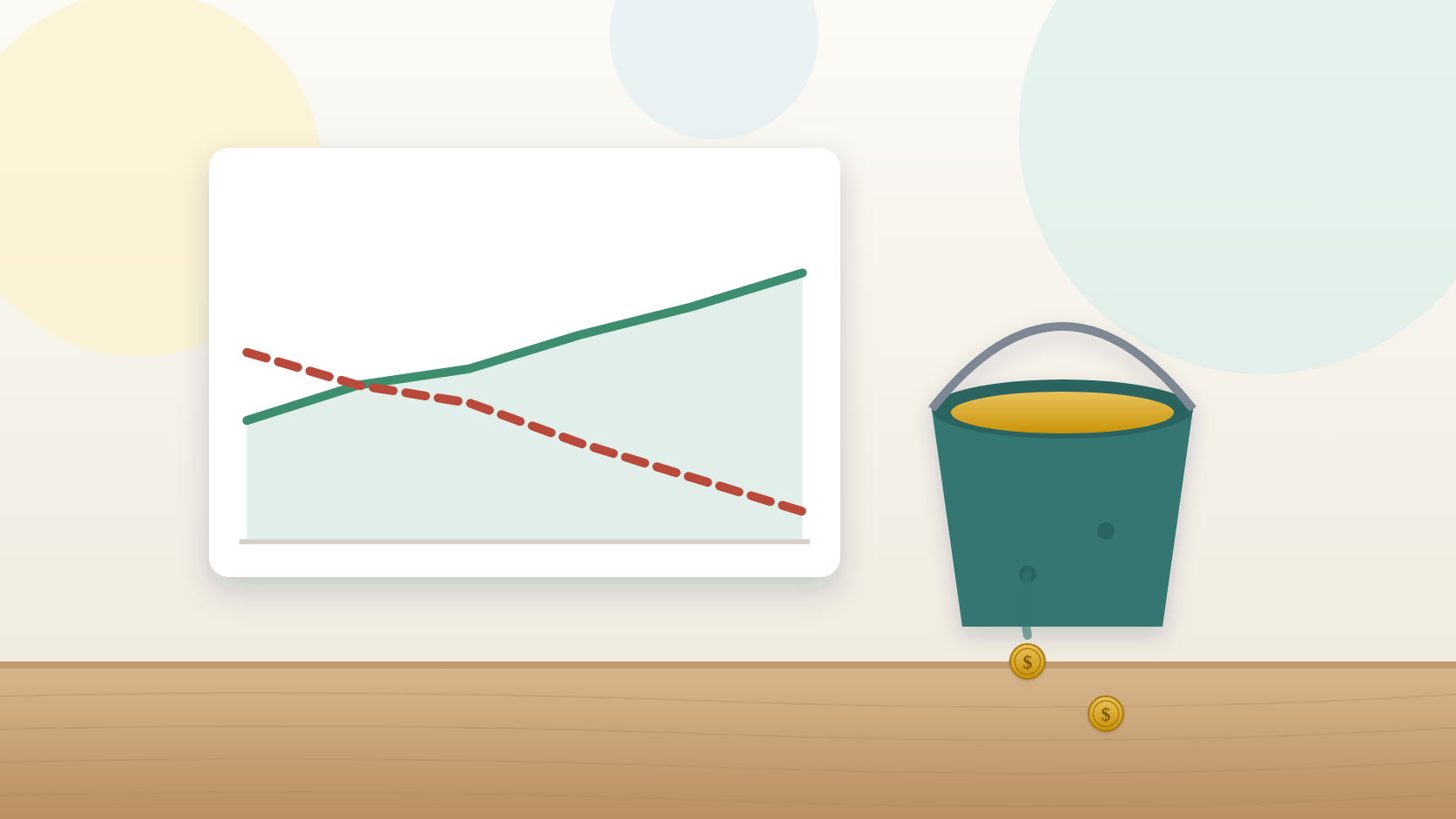
Cash Flow Isn't Profit — and the Gap Can Sink You
Profit and cash flow aren't the same thing. Here's why profitable businesses still run out of money — and the weekly habit that prevents it.
Here's a scene I've watched play out more than once. An owner is looking at a profit-and-loss statement that says the business made money last quarter. Real money. And they are also looking at a bank balance that will not cover Friday's payroll. Both numbers are correct. Both are on the same business. And the owner is staring at them trying to work out which one is lying.
Neither is lying. They are measuring two different things, and the day you understand the difference is the day the business stops surprising you.
Profit is an opinion; cash is a fact
Profit is what's left after you subtract your expenses from your revenue. It's counted on paper, over a period, using rules about when a sale "counts." Under those rules, a sale counts the moment you deliver the work — not the moment the customer actually pays you. So you can book a profitable month while the money is still sitting in someone else's account.
Cash flow is different. Cash flow is the real money moving in and out of your account, right now. Not what you earned. What you have.
Most of the time the two move together, and you never have to think about the gap. Then something ordinary happens — a big customer pays sixty days late, you buy a season's worth of inventory up front, you make a loan payment — and the two numbers split apart. Profit says one thing. The bank says another. And it's the bank that decides whether you make payroll.
That's the whole idea, and it's worth saying plainly: you can be profitable and still run out of cash. Profitability tells you whether the business model works over time. Cash flow tells you whether you survive until then.
Where the gap actually comes from
Three ordinary things open the gap, and none of them mean you did anything wrong.
The first is timing. You did the work in March, but the customer pays in May. March looks profitable. April's rent still comes out of an account that hasn't been paid yet.
This isn't a manufacturing-only problem. A consulting firm that bills net-60 does the work in January and sees the money in March, but the office lease and the salaries don't wait. A landscaping crew buys a season of materials in April and gets paid across the summer. The more your customers pay you after you've done the work — and the more you have to spend before you can sell — the wider the gap, and the more a profitable business can feel broke.
The second is money you spend that never shows up as an "expense." When you buy equipment or stock up on inventory, that cash leaves your account, but accounting treats it as trading one asset (cash) for another (the thing you bought). Your profit barely moves. Your bank balance drops like a stone.
The third is what you owe. Loan payments, tax set-asides, paying down a supplier — real cash going out that a profit number doesn't fully capture.
Put those together and you get the trap: a business that is genuinely earning money and genuinely cannot pay its bills, at the same time, for a stretch long enough to end it.
What it looks like: the roaster who did everything right
Let me make this concrete with a small business. Maya runs a coffee roaster and café. Good margins, loyal customers, a growing wholesale side. On paper, a healthy operation.
One spring she gets a chance to lock in a price on a season's worth of green coffee beans — thirty thousand dollars, paid up front, and a genuinely smart move because bean prices were about to climb. She takes it.
That month, her profit-and-loss statement still looks fine. The beans aren't an "expense" yet; they're inventory sitting in her storeroom. But her checking account just dropped thirty thousand dollars, and the coffee won't turn back into cash until she roasts it, sells it, and — for the wholesale accounts — waits for the restaurants to pay their invoices.
For a few weeks, Maya is profitable and broke. Nothing went wrong. She made a good decision. She just didn't watch the gap between profit and cash, and the gap nearly caught her.
The fix wasn't a better P&L. It was a cash flow forecast — a simple week-by-week look at what's actually coming in and going out — so she could see the thin stretch before she committed, and either time the order differently or keep a bigger buffer.
The habit that keeps this from happening to you
You don't need an accounting degree to stay ahead of this. You need one habit: watch cash on its own, separately from profit, and watch it forward, not just backward.
Practically, that's a short weekly look at three things. What's coming in and roughly when — including which customer invoices are still unpaid. What's going out and when — rent, payroll, loan payments, the big supplier bill. And what the balance will be at the low point over the next few weeks, not just today.
Three levers keep that low point off the floor. Collect faster: invoice the day the work is done, not the end of the month, and make it easy to pay you. Pay smart: use the terms your suppliers give you instead of paying everything the instant it lands. And keep a buffer — a cushion that turns a late payment from a crisis into a shrug.
Finance people have a name for the underlying idea: the cash conversion cycle — the stretch of time between when cash leaves your hands and when it comes back. Shorten it and cash troubles mostly disappear. You shorten it by collecting from customers sooner, moving inventory faster so it isn't sitting as frozen cash, and taking the full, fair payment terms your suppliers offer instead of paying early out of habit. None of that is exotic. It's just paying attention to when money moves, not only whether you made a profit.
This is exactly the kind of work AI is good for now. You can hand a tool your numbers and have it build the forecast, flag the week your balance dips, and show you what a late-paying customer does to the picture — in seconds. What it can't do is decide whether to make the bean order, chase the slow customer, or hold the line on your buffer. It does the arithmetic. You make the call. That's the whole game: the tool amplifies your judgment, it doesn't replace it.
The one caveat
Cash flow discipline is not the same as being cheap, and it's not an argument against investing in your business. Maya's bean order was the right move — locking in a price before it rose is exactly what a sharp operator does. The point isn't "never spend." The point is to see the cash consequence before you commit, so you're choosing the thin stretch on purpose instead of discovering it on payroll Friday.
Profit tells you the business is worth running. Cash flow makes sure you're still around to run it. Watch both. They are not the same number, and the difference between them is where good businesses quietly die.
Key takeaways
- Profit is measured on paper over a period; cash flow is the real money in your account right now.
- A profitable business can still run out of cash when payments are slow or big purchases hit up front.
- Buying inventory or equipment barely moves profit but drains cash immediately.
- A weekly, forward-looking cash flow check catches the thin stretch before it becomes a crisis.
- AI can build the forecast in seconds; the decision about what to do stays yours.
Frequently asked questions
What is the difference between cash flow and profit?
Profit is what's left after you subtract expenses from revenue, counted on paper over a period of time. Cash flow is the actual money moving in and out of your bank account. Profit can count a sale before the customer pays; cash flow only counts money you actually have. A business can be profitable and still run out of cash.
Why do profitable businesses run out of money?
Usually because of timing and big up-front spending. You can earn a profit in one month but not get paid until two months later, while rent and payroll still come due. Buying inventory or equipment drains cash without showing as an expense. So the profit number looks healthy while the bank account runs dry.
How can a small business avoid a cash crunch?
Watch cash separately from profit, and watch it forward. Each week, look at what's coming in and when, what's going out and when, and your lowest balance over the next few weeks. Invoice quickly, collect faster, use supplier payment terms, and keep a cash buffer so a late payment is a nuisance instead of an emergency.
Does a profit and loss statement show cash flow?
No. A profit and loss statement shows revenue, expenses, and profit over a period, but it counts sales when they're earned, not when cash arrives, and it doesn't fully show money spent on inventory, equipment, or loan repayment. To see cash, you need a cash flow statement or a simple week-by-week cash forecast.
Read the money without the jargon
This is one piece of the finance module in Business Essentials, where you learn to read a company's income statement, balance sheet, and cash flow — and build a one-page snapshot of any business's health.
See the course